Maison Verlaine traces its origins to a tradition of French pâtisserie defined by discipline, balance, and continuity. From its earliest days, the atelier has favored restraint over spectacle, allowing reputation to grow through consistency rather than promotion.
The work continues today as it always has—guided by inherited standards, practiced daily, and refined over time.
The foundations of Maison Verlaine were established generations ago by a French pâtissier whose work became quietly sought after for its precision and restraint. Rather than pursuing recognition, the atelier earned its reputation through repetition, discipline, and an uncompromising respect for craft.
That knowledge was passed forward not as a formula, but as a responsibility. Techniques, standards, and expectations were learned through years of observation and practice—preserved through continuity rather than reinvention.
Trained within the same tradition she inherited, Élodie continues the work as its steward. Her role is not to redefine the atelier, but to preserve its standards—ensuring that each decision reflects the values established long before her time.
The work remains deliberate, practiced daily, and guided by consistency rather than novelty.
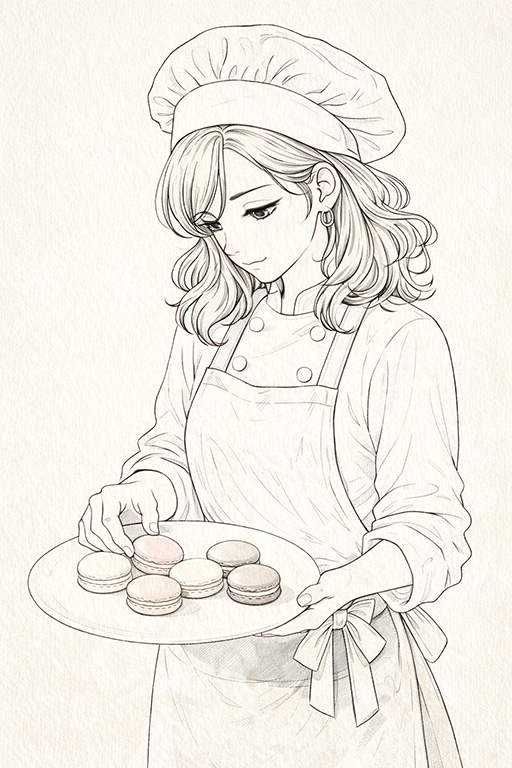
At Maison Verlaine, restraint is not an aesthetic choice—it is a principle. Ingredients are selected for their purity rather than intensity, and flavors are allowed to remain natural, unembellished, and balanced.
Artificial dyes and additives are avoided entirely. Color is treated as a byproduct of ingredients, not a feature to be engineered. The result is a macaron defined by structure, texture, and flavor rather than spectacle.
The atelier continues to operate on a daily rhythm shaped by tradition. Production remains intentionally limited, dictated by standards rather than demand. Each macaron reflects the same expectations upheld across generations—prepared with care, consistency, and restraint.
Availability varies, not as a strategy, but as a consequence of maintaining those standards.